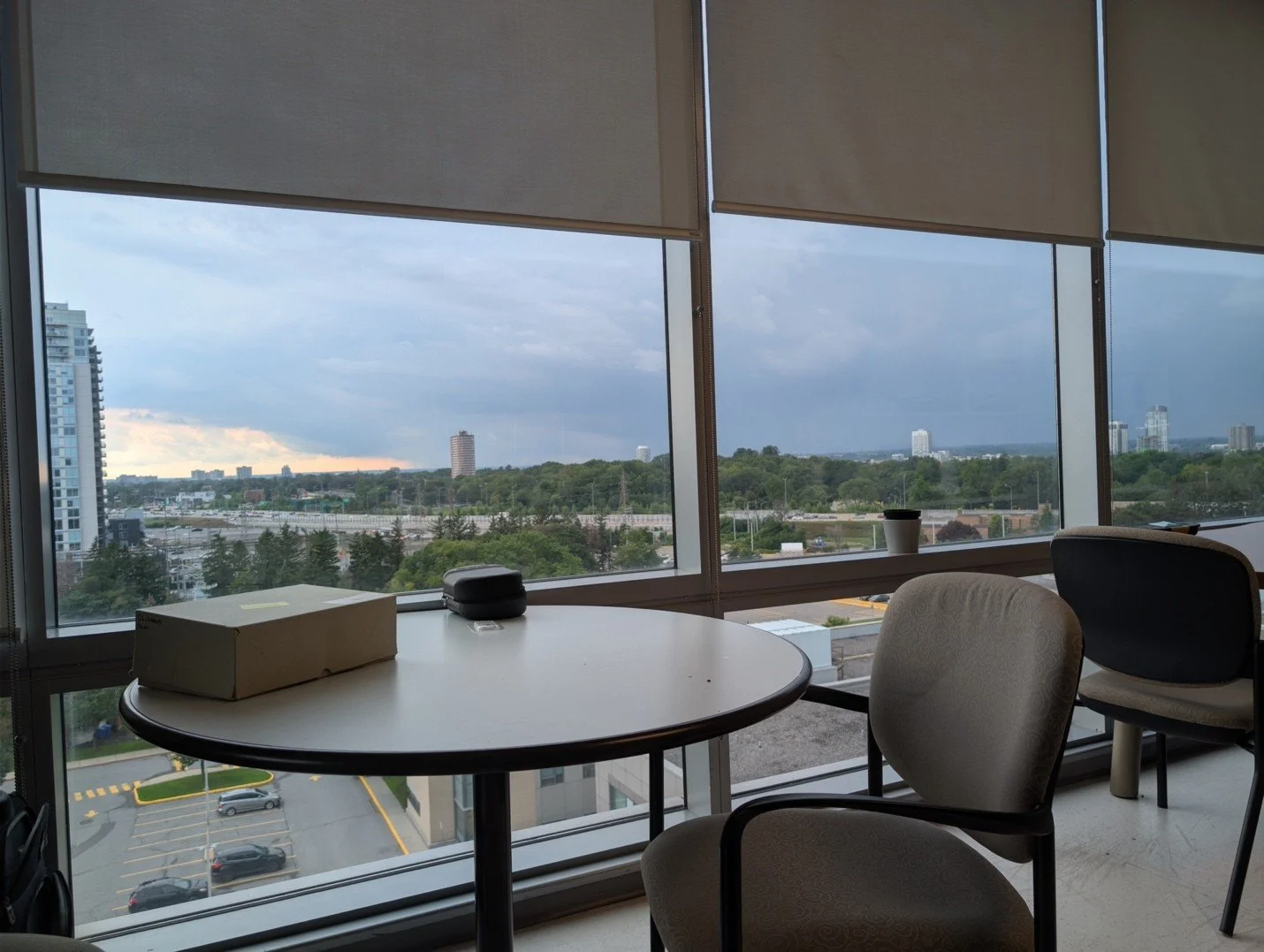
Kirsten Gong’s Lab Exchange at uOttawa Institute of Mental Health Research at the Royal
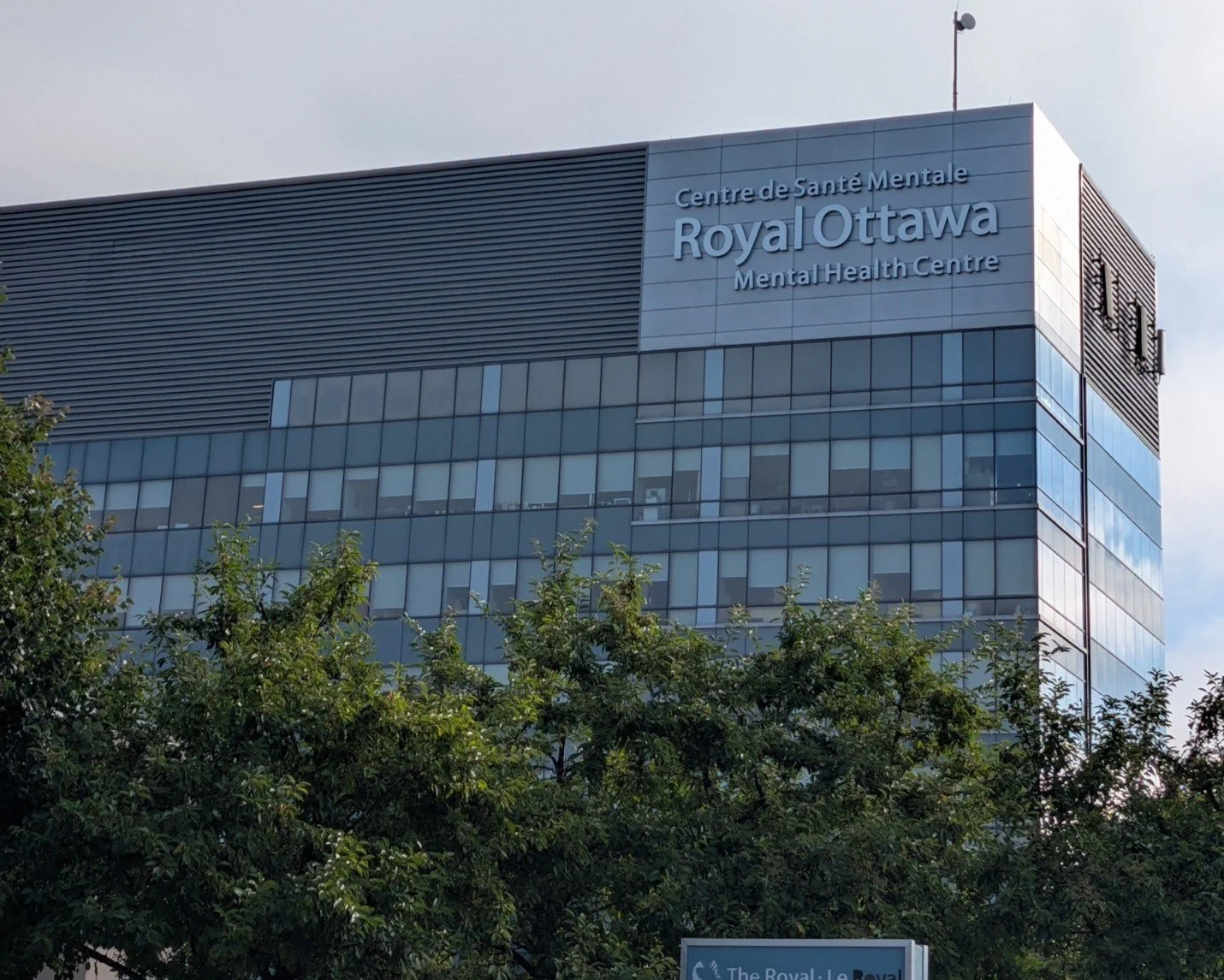
I am extremely grateful to the Canadian Sleep Research Consortium for supporting my lab exchange at Dr. Rébecca Robillard’s lab in Ottawa, Ontario. Although Dr. Rébecca Robillard is my co-supervisor, this was my first opportunity to spend meaningful time in her lab, work closely with her research team, and gain valuable new research skills in-person.
The electroencephalographic (EEG) data that I worked on were collected over a span of about 7 years from war veterans with PTSD and healthy controls. Brain activity was recorded during two 10-minute auditory tasks, first with fast and then with slow stimulus presentation rates. Over the course of five days, I expanded my knowledge in the theory of ERPs, mastered the pre-processing steps using BrainVision Analyzer, and learned how to analyze and interpret the ERP findings.
The Facts
Who? Kirsten Gong, PhD Student, Concordia University
Supervisor: Dr. Thien Thanh Dang-Vu, Sleep, Cognition and Neuroimaging Laboratory (SCNLab)
What? Canadian Sleep Research Consortium Lab Exchange Program
When? August 2026
Where? Sleep Research Unit, University of Ottawa Institute of Mental Health Research at the Royal and the Insomnia & Mental Health Team
Partnered Investigators: Dr. Rébecca Robillard and Dr. Paniz Tavakoli
Why? To receive training in how to pre-process raw electroencephalographic (EEG) data for event-related potential (ERP) analyses as well as analyzing ERP data
Expanding my methodological toolbox
One of my research projects for my PhD thesis assesses if there are differences in resting-state functional connectivity and brain activity during a personalized word-related task between war veterans with post-traumatic stress disorder (PTSD) and healthy controls. While my primary expertise is in functional magnetic resonance imaging (fMRI) and polysomnography, I wanted to broaden my skill set. To do this, I chose to work on the same larger parent study that my thesis is on but using a method that I never had the opportunity to learn until now: event-related potentials (ERPs).
From raw signals to meaningful components: A 5-day journey into learning ERP analyses
Day 1: Upon arrival at The Royal, I was greeted by Dr. Rébecca Robillard and went to the lab. Some research assistants, students, and I then attended a three-hour ERP workshop led by Dr. Rébecca Robillard’s former postdoc, Dr. Paniz Tavakoli. In addition to covering the theoretical foundations of ERPs, including what they are, how they are evoked, where they are most dominant, the different components (e.g., N1 and P2), and simple paradigms, we learned about how to organize the dataset and how to pre-process the EEG data using BrainVision Analyzer. Dr. Paniz Tavakoli meticulously detailed each step of the pre-processing pipeline, outlining both the procedure and its rationale, using a real dataset from a larger parent study. At the end, we discussed any questions we had as a group. I also then met one-on-one with Dr. Paniz Tavakoli to discuss any specific questions I had as well as the plan for the week. I then practiced pre-processing the data on multiple subjects using a test workspace before I started pre-processing all the data using the real workspace.
Day 2: As there were many subjects in the database and two tasks per participant, I continued to pre-process the data all morning. I then met one-on-one with Dr. Paniz Tavakoli in the afternoon to discuss any remaining questions I had after starting the pre-processing on my own. Dr. Paniz Tavakoli showed me how to extract other metrics aside from the amplitude of different ERP components, such as the latency.
Day 3: After pre-processing all the data, I extracted the amplitude and latency of the different components for each group and then for each participant. I built a dataset in Excel and SPSS containing the values I extracted along with demographic and self-report questionnaire data. This enabled me to add covariates to my linear models or run correlations with behavioural data. I subsequently created an R script to run statistical analyses and plot graphs.
Day 4: I ran the R script, analyzed the data, and then added tables and figures to a PowerPoint presentation. I also helped retrieve some missing self-report questionnaire data while flagging data that I was still missing. This step was extremely important and useful as part of my thesis utilizes the same dataset. I also ran some exploratory correlations between the ERP metrics and self-report questionnaire data.
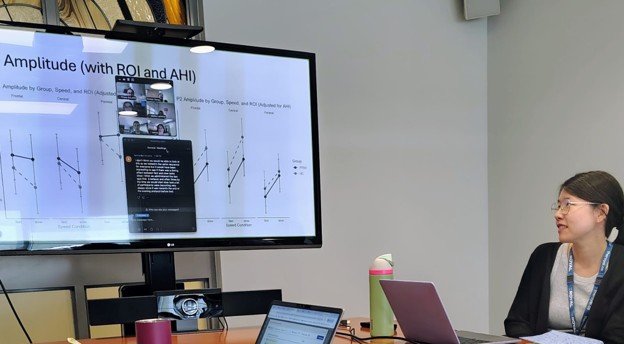
Day 5: On my final day, I met with Dr. Paniz Tavakoli once again to discuss any questions I had regarding the results I found and the potential interpretation of the findings. I presented the research findings during a hybrid meeting, where I presented on-site while simultaneously streaming to remote attendees via Zoom. Following the presentation, we conducted a group discussion about the results and evaluated potential next steps. For instance, we discussed other analyses that could be done on the same dataset as well as the ability to continue this work in Montreal. Additionally, we learned about the practical applications of ERP analyses in a clinical context.
What’s next?
Although my lab exchange is over, it is not the end. I look forward to continuing this work alongside my PhD or after its completion and hopefully helping to get it published in the future. Even though we do not currently collect EEG data for ERP analyses at the SCNLab, I would be thrilled to share my knowledge with others. This whole experience not only expanded my skill set, but also opened new doors for my career by making me a more equipped and well-rounded researcher. I wholeheartedly encourage any student who is thinking about doing this lab exchange to do it.
Once again, I would like to thank the Canadian Sleep Research Consortium for this wonderful initiative and to Dr. Rébecca Robillard and Dr. Paniz Tavakoli for their support, mentorship, and time. I would also like to thank her research assistants, students, and staff for their warm welcome, kindness, and assistance. I am grateful for the wonderful friendships that grew out of our short time working together.