
Insomnia Research
What is insomnia?
Many of us have a poor night of sleep from time to time… this is normal. However, some people struggle with sleep on a regular basis and face serious challenges to get by with their days. There is a continuum from the occasional sleep difficulty to chronic insomnia disorder. Insomnia disorder involves persistent difficulties falling asleep, staying asleep, or both. This has clear impacts on daytime functioning, such as fatigue, concentration or memory problems, and poor mood.
What can we do about it?
When we are facing occasional sleep problems, simple tips can be helpful to prevent any worsening and to fast track the return to better sleep. However, when insomnia problems get more serious, regular and persist over time, treatment is required.
The first treatment that should be provided for insomnia disorder is cognitive behavioral therapy for insomnia (CBT-I).
CBT-I
Is based on over 35 years of research and clinical experience
Works by:
Breaking down sleep-related habits and thought patterns that maintain insomnia over time
Progressive and personalized adjustments of the sleep schedule to naturally strengthen sleep quality
Learning about how sleep works and what strategies can be used to combat difficulties falling or staying alseep
Does not involve any sleeping pill
Offers better long-term benefits than sleeping pills
Participate in a research study offering free access to CBT-I
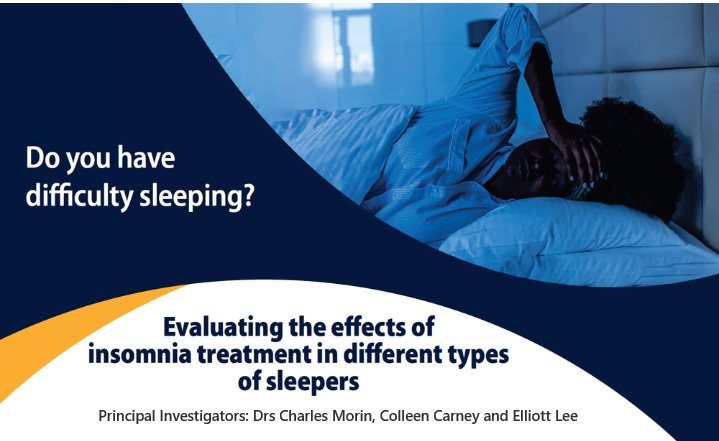
This clinical study assesses the effects of insomnia treatment across different insomnia subtypes.
You may be able to access an intervention for the treatment of insomnia if you:
Are 18 and over;
Experience difficulty sleeping (insomnia);
Do not have serious medical conditions;
Do not use any medications or products for sleep OR agree to stop using them at least two weeks before the study begins and throughout its duration.
Participation in this project may involve psychological treatment (cognitive behavioral therapy (CBT-I) or taking a medication approved by Health Canada for the treatment of insomnia. The treatment involves six consultations about once a week for eight weeks and a follow-up six months later. Consultations can take place in person or remotely, depending on your preference. Monetary compensation is provided for your participation.
For more information
Ottawa/Gatineau Region
Email: InsomniaClinic@TheRoyal.ca
Phone: 613-722-6521 ext. 6100
Toronto Region
Email: sadlab@torontomu.ca
Phone: (416) 979-5000 ext. 552185
Quebec City Region
Phone: 418-656-3075 or 1-866-656-3075 (no fee)

iCANSleep Study
The iCANSleep research study was developed by the Sleep, Health, and Wellness Lab at Memorial University of Newfoundland. We are investigating innovative ways to deliver an insomnia treatment, Cognitive Behavioural Therapy for Insomnia (CBT-I), to cancer survivors. The iCANSleep app is specifically tailored to the unique needs of cancer survivors. We are currently testing the feasibility and acceptability of the iCANSleep app; it is not available on the app store yet. Once our testing is complete, we will have a fully developed insomnia treatment app for cancer survivors on both iOS and android OS devices to access on the app store for free.
To participate, you need to:
Have ever been diagnosed with cancer
Have difficulty falling or staying asleep
Are over 18 years old
Are an iPhone user
Live in Canada
Have completed all treatments or have been considered clinically stable for at least 3 months
For questions, please contact:
Principal Investigator: Sheila Garland, PhD.
Website: https://icansleep.app/

Novel methods to increase access and facilitate CBT-I in the context of depression
This research aims to better understand the effect of an intervention based on CBT-I on sleep, mental health, heart rate, and brain activity. This study also investigates if using a wearable sleep devices during the insomnia intervention may improve outcomes and satisfaction.
To participate, you need to:
Be between 18 and 65 years of age
Experiencing symptoms of insomnia and depression
For questions, please contact:
613-722-6521 ext.6493
Principal Investigator: Rébecca Robillard, Ph.D.
REB#2022030

Measuring Insomnia Treatment Response in Breast Cancer
We are currently looking for cancer survivors who have struggled with insomnia to participate in Cognitive Behavioural Therapy for Insomnia (CBT-I). Before and after treatment, participants will also complete cognitive assessments and use the Cerebra Sleep System, an in-home polysomnography, to measure sleep. The purpose of this study is to understand how a new measure of sleep depth and quality changes in response to CBT-I in breast cancer survivors. We are also interested in how these changes in sleep are related to changes in cognitive functioning. CBT-I is a multicomponent treatment designed to address behaviors and thoughts that are known to influence the development and maintenance of sleep difficulties. CBT-I is the recommended treatment for chronic insomnia and has been shown to improve sleep in the general population and in cancer survivors.
To participate, you need to:
Have been diagnosed with stage I-III breast cancer
Have difficulty falling or staying asleep
Have received and completed all treatments (not including hormonal therapies) at least 6 months prior to today
Live in or around St. John’s, NL
For questions, please contact:
Sleep, Health, & Wellness Lab at (709) 864-4897 or sleeplab@mun.ca
Principal Investigator: Sheila Garland, PhD
Other resources for CBT-I
Books
Evidence-based digital self-help tools and websites
Since CBT-I is often offered by trained psychologists, you can also contact your province's psychologists college.
Click HERE to access the list of Provincial and Territorial regulatory bodies.
